
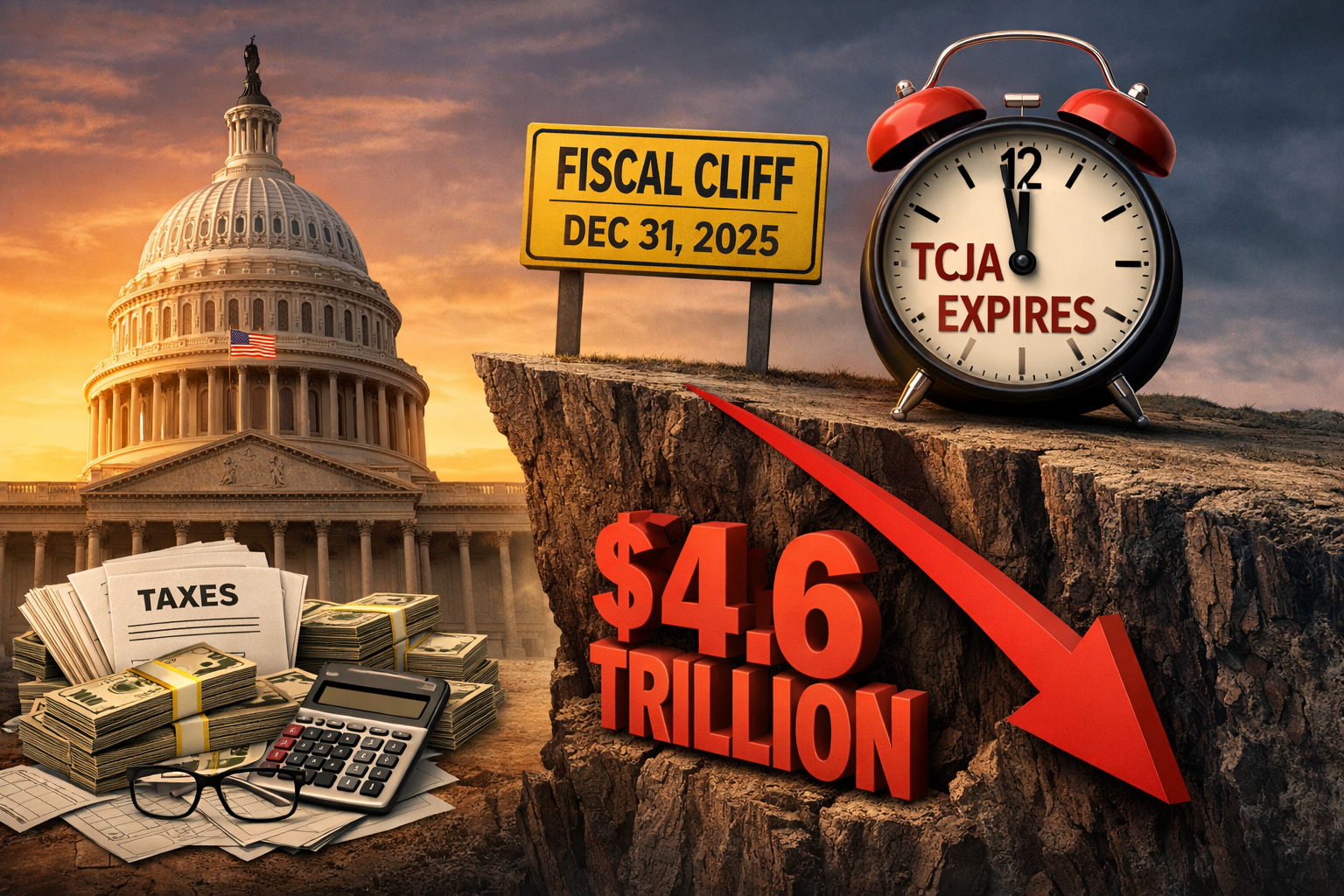
WASHINGTON The United States is approaching the most consequential fiscal deadline in nearly a decade. On December 31, 2025, the individual income tax provisions of the 2017 Tax Cuts and Jobs Act are scheduled to expire, triggering what analysts describe as a broad, automatic tax increase for a majority of American households.
As lawmakers return from winter recess, the long-anticipated TCJA sunset has shifted from a distant budget scenario to an urgent legislative problem. The Congressional Budget Office now estimates that a full extension of the expiring provisions would add $4.6 trillion to federal deficits over the next ten years, placing Washington at a familiar crossroads: allow the cuts to lapse and risk a shock to household consumption, or extend them and significantly worsen the long-term debt outlook.
For taxpayers, the implications are immediate and mechanical. Absent congressional action, the 2026 tax year will bring higher marginal rates, a sharply reduced standard deduction, and a smaller Child Tax Credit. Markets and policymakers are already positioning for the economic aftershocks.
Policy Details: How the TCJA Reversion Works
The TCJA was structured with built-in expirations to comply with Senate budget rules, meaning the sunset is not a single change but a cascade of reversions. Under current law, the following provisions take effect beginning in the 2026 tax year (filed in early 2027):
Individual Income Tax Rates
The current seven-bracket system will revert to pre-2018 levels, raising marginal rates across most income bands and restoring the top rate to 39.6%.
Standard Deduction
The nearly doubled standard deduction currently $29,200 for married joint filers and $14,600 for single filers at recent inflation-adjusted levels will be roughly halved. Analysts estimate that tens of millions of households would return to itemizing deductions, increasing compliance costs and audit exposure.
Child Tax Credit
The credit would fall from $2,000 per child to $1,000, while income phase-out thresholds would drop sharply, eliminating eligibility for many upper-middle-income families.
SALT and Itemized Deduction Limits
The $10,000 cap on state and local tax deductions would expire, benefiting high-income filers in high-tax states. However, the return of the Pease limitation would reduce the overall value of itemized deductions for higher earners.
Pass-Through Deduction
The 20% deduction for qualified business income under Section 199A would disappear entirely, raising the effective tax burden on millions of small business owners.
Who Benefits and Who Bears the Cost
The distributional impact of a full sunset is uneven and politically complex.
Middle-Income Households:
Families earning between roughly $50,000 and $150,000 would see the largest relative increase in tax liability, driven by the loss of the expanded standard deduction and Child Tax Credit.
High-Income Filers in High-Tax States:
The end of the SALT cap would provide relief, particularly in states such as New York and California. However, higher top marginal rates and the reinstated Pease limitation would offset much of the benefit.
Small Business Owners:
The expiration of the Section 199A deduction represents a substantial tax increase on pass-through income, regardless of industry.
Federal Finances:
From a fiscal perspective, allowing the sunset to occur would improve the federal revenue outlook, reducing projected deficits by nearly $4 trillion over a decade.
Economic Impact: Growth Versus Stability
Economists at the Treasury and the Federal Reserve are modeling the TCJA sunset as a contractionary fiscal shock.
Consumer Spending
A full reversion would reduce household disposable income, potentially lowering consumer demand by an estimated 0.5% to 1.0% of GDP in 2026. While disinflationary in theory, the hit to cash flow could amplify downside growth risks.
Labor Markets
Higher marginal rates on pass-through income could dampen hiring and investment among small and mid-sized firms, particularly in services and construction.
Market Implications
Bond markets appear to be pricing a temporary extension scenario. However, a surprise lapse could lower long-term Treasury yields by improving the government’s revenue outlook and reducing future debt issuance.
Political Reality in Washington
A legislative fix remains uncertain.
Republicans broadly support extending the TCJA provisions, but the cost makes a clean extension difficult without spending cuts. Democrats, meanwhile, have signaled willingness to allow higher rates on top earners to return while conditioning any middle-class relief on an expanded Child Tax Credit.
A bipartisan group of lawmakers from high-tax states continues to push for SALT relief, further complicating negotiations.
Historical Context
The standoff echoes the 2012 “Fiscal Cliff,” when Congress delayed action on expiring Bush-era tax cuts until the final hours of the year. In that case, lawmakers allowed rates to rise on high earners while preserving middle-class provisions retroactively.
Many analysts expect a similar outcome this time a late-stage compromise that leaves the Internal Revenue Service facing major administrative challenges during the 2026 filing season.
Institutional Views
“This is fiscal policy on a scale that dwarfs the 2012 episode,” said an analyst at the Tax Foundation, noting the complexity of rewriting individual tax rules for more than 150 million filers.
Research notes from major banks suggest a partial extension preserving lower rates and the standard deduction for households below certain income thresholds is the most likely baseline.
The Committee for a Responsible Federal Budget has warned that extending the TCJA without offsets would significantly worsen the long-term debt trajectory.
What Comes Next
Negotiations are expected to intensify after the 2025 election, with a final vote likely during a late-year or early-2026 session. Any retroactive fix would increase pressure on the IRS and could delay the start of the filing season, affecting refund timelines for millions of taxpayers.
Summary
The TCJA sunset represents a defining fiscal decision for the United States. Whether lawmakers choose to extend the cuts, allow a reversion, or settle on a partial compromise will shape household finances, federal deficits, and economic growth well into the next decade. For now, markets, taxpayers, and policymakers are preparing for a period of prolonged uncertainty.
Financial Disclaimer
This article is provided for informational and journalistic purposes only. It does not constitute tax, legal, financial, or investment advice. Policy outcomes and tax rules are subject to legislative change. Readers should consult qualified professionals for guidance specific to their circumstances. The publisher assumes no liability for actions taken based on this information.