
Published: March 2, 2026 | Geopolitical Analysis
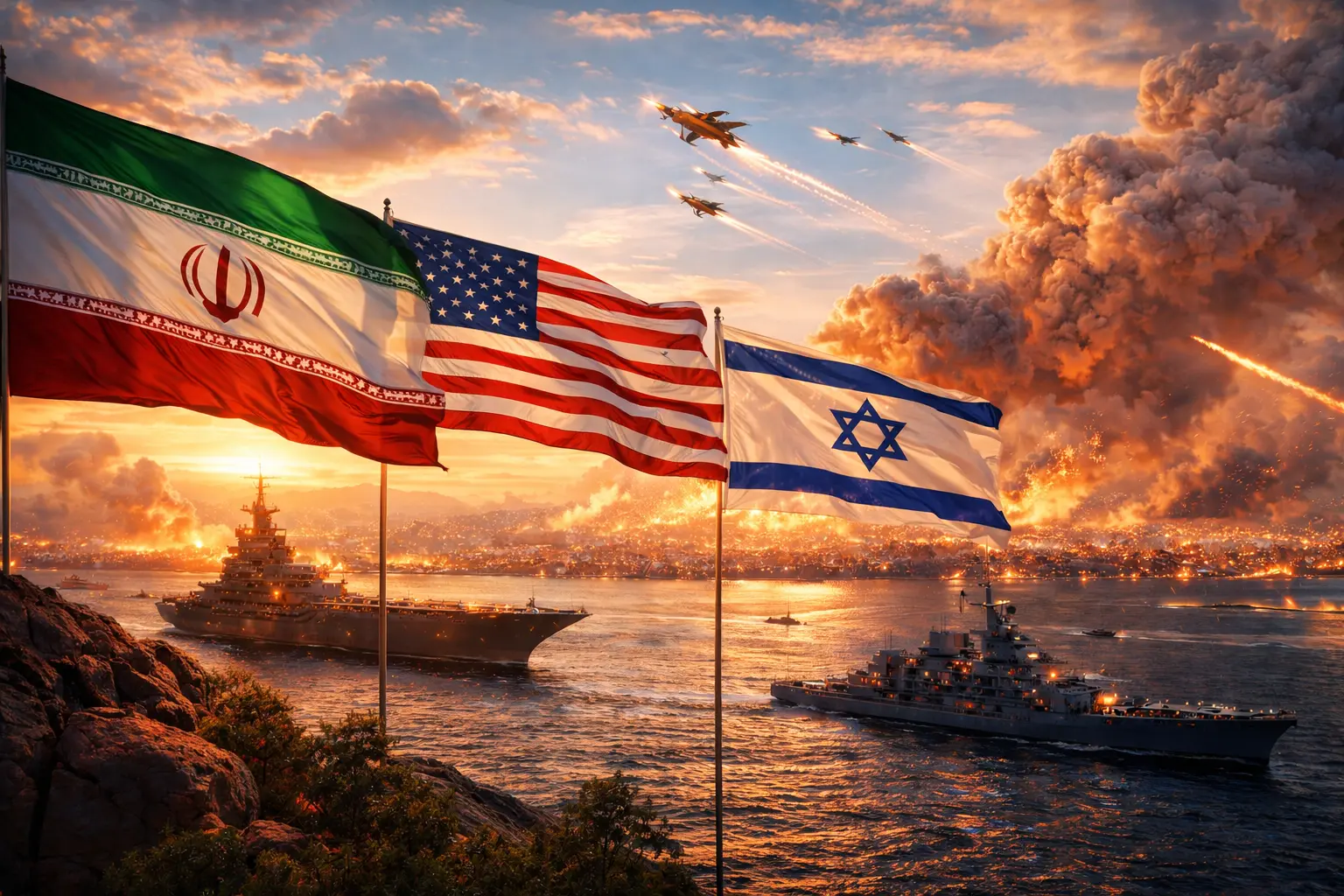
In a coordinated military operation that has reshaped the strategic landscape of the Middle East, the United States and Israel launched sweeping strikes across Iran on February 28, 2026, killing Supreme Leader Ayatollah Ali Khamenei and several senior military figures, targeting nuclear and missile infrastructure, and prompting immediate retaliation from Tehran. Within hours, Iran closed the Strait of Hormuz and launched missile and drone attacks across the region, opening a volatile new phase in an already fragile geopolitical order.
The scope of the operation, the decapitation of Iran’s highest leadership, and the activation of Iran’s regional deterrence network mark one of the most consequential escalations in the region in decades. The conflict now carries profound military, political, humanitarian, and economic implications extending far beyond the immediate battlefield.
The Offensive: Scope and Strategic Design
According to U.S. and Israeli officials, the operation designated “Operation Epic Fury” by Washington and “Operation Roaring Lion” by Jerusalem targeted nuclear enrichment facilities, ballistic missile infrastructure, Islamic Revolutionary Guard Corps (IRGC) command centers, and senior leadership compounds across Tehran, Isfahan, Qom, Karaj, and Kermanshah.
Officials described the campaign as the product of months of intelligence coordination and joint planning. By striking both physical infrastructure and senior leadership simultaneously, the operation appeared designed to degrade Iran’s military capabilities while destabilizing its command structure.
Iranian state media confirmed the death of Supreme Leader Ayatollah Ali Khamenei. At least seven senior IRGC commanders including Ali Shamkhani, Aziz Nasirzadeh, and Mohammad Pakpour were also reported killed. Subsequent strikes on March 1 reportedly killed additional senior figures, including Abdolrahim Mousavi and former President Mahmoud Ahmadinejad. Independent verification of all reported deaths remains limited due to restricted access within Iran.
If confirmed in full, the leadership losses would represent the most significant decapitation strike against a sovereign adversary in the post-9/11 era.
Stated Objectives and Strategic Calculations
In a February 28 address, President Trump said the strikes were intended to permanently dismantle Iran’s nuclear and ballistic missile programs and create conditions for internal political change. Israeli Prime Minister Benjamin Netanyahu and Foreign Minister Israel Katz characterized the operation as a preemptive response to what they described as an existential threat.
The strategy appears to rest on two key assumptions: that eliminating senior leadership would weaken the regime’s cohesion, and that a rapid, high-intensity strike would prevent a prolonged shadow conflict.
Historical precedent offers mixed evidence. Leadership decapitation has, in some cases, accelerated regime fragmentation. In others, it has consolidated domestic support through nationalist mobilization. Iran’s experience during the Iran-Iraq War in the 1980s demonstrates the state’s capacity to rally public sentiment under external threat.
Whether the current strategy produces fragmentation or consolidation will likely depend on the succession process now unfolding within Iran’s political and security institutions.
Iran’s Retaliation and Regional Spread
Iran’s response was immediate and geographically expansive. Swarms of drones and ballistic missiles targeted U.S. and allied military installations in Qatar, the United Arab Emirates, Kuwait, Bahrain, Iraq, Saudi Arabia, Jordan, and Israel.
U.S. Central Command reported that allied missile defense systems intercepted most incoming projectiles. However, several strikes penetrated defenses. On March 1, a missile hit Beit Shemesh in Israel, killing nine people and injuring 28. Another strike on a Tel Aviv residential area killed one civilian and wounded 27 others.
U.S. officials confirmed three American service members killed and five seriously wounded across regional installations. Two members of Iraq’s Popular Mobilization Forces were killed. In the UAE, falling debris from intercepted munitions killed one Asian national.
Iran’s Foreign Ministry, led by Abbas Araghchi, declared U.S. and Israeli assets worldwide legitimate targets and cited Article 51 of the UN Charter in defense of its actions. Legal scholars note that the applicability of self-defense claims depends in part on interpretations of the legality of the initial strikes a question likely to remain contested.
While the volume of Iran’s retaliation demonstrated significant capacity, the interception rate suggests limitations in precision and penetration capability against hardened targets. Nonetheless, analysts caution that Iran retains the ability to sustain attritional pressure and threaten civilian infrastructure over time.
Regional Alignments Under Strain
The escalation has placed Gulf states in a precarious position. Qatar, the UAE, Bahrain, Kuwait, and Saudi Arabia host U.S. military installations yet did not formally endorse the strikes. Iranian retaliation against facilities on their territory underscores their exposure to the conflict.
Iraq remains particularly vulnerable. Hosting both U.S. forces and Iranian-aligned Popular Mobilization Forces, Baghdad’s territory has become an indirect battleground. The killing of PMF members during retaliatory exchanges highlights the internal tensions this conflict may intensify.
Russia and China, both key partners of Iran, have not announced military commitments. Their diplomatic posture could influence whether the confrontation remains regionally contained or expands into broader strategic competition.
NATO forces have elevated readiness levels across the Mediterranean and Eastern Europe. The United Nations Security Council faces structural limitations in imposing ceasefire measures due to anticipated veto divisions among permanent members.
Civilian Impact and Information Contestation
Humanitarian consequences are mounting. Iran’s Red Crescent reported 201 civilian deaths and 747 injuries from the February 28 strikes. These figures have not been independently verified.
Iranian authorities allege that a strike in the southern city of Minab hit a girls’ school, killing between 148 and 165 people. U.S. and Israeli officials deny targeting civilian infrastructure and state that only military and nuclear-related sites were engaged. Independent observers have not confirmed the Minab claims due to restricted access.
The competing narratives underscore a parallel information conflict. Verification challenges complicate international legal assessments and public opinion abroad.
The strikes follow widespread anti-government protests inside Iran earlier in January. Casualty figures from that unrest remain highly contested, with government, activist, and U.S. estimates diverging sharply. The information environment remains opaque.
Economic Fallout and the Strait of Hormuz
Iran’s closure of the Strait of Hormuz represents a significant escalation in economic terms. Approximately 20% of global oil supply transits the strait. Maritime tracking services report more than 150 vessels stranded.
Prior to the strikes, Brent crude had risen to $71.14 per barrel and West Texas Intermediate to $66.02, reflecting pre-existing escalation concerns. Analysts warn that sustained disruption could push prices above $90 per barrel.
An estimated 18 million barrels per day of Gulf production would require longer alternative routes if the strait remains blocked. Iran’s own exports of roughly 2 million barrels per day could also be affected.
Higher energy costs would likely increase freight, insurance, and industrial input prices, potentially reintroducing inflationary pressures across major economies. Central banks already navigating sensitive monetary policy cycles may face renewed challenges.
What Happens Next?
The immediate uncertainty centers on Iran’s leadership succession. The Islamic Republic does not have a wartime-tested succession framework for the sudden loss of a Supreme Leader. Competing factions within the IRGC, the Assembly of Experts, and civilian leadership structures may vie for authority.
A fragmented power structure could generate unpredictable short-term escalation. Alternatively, internal consolidation could stabilize decision-making while prolonging confrontation.
Iran’s enforcement of the Strait of Hormuz closure is unlikely to be indefinitely sustainable against multinational naval power. The blockade may function as leverage in potential negotiations rather than a permanent posture.
Diplomatic engagement from European states, China, India, and Japan all heavily exposed to energy market disruption could prove pivotal in shaping de-escalation efforts.
The trajectory will also depend on domestic sentiment within Iran. Whether citizens rally around successor leadership or press for structural change remains uncertain and largely beyond external control.
A Reshaped Strategic Landscape
The events of February 28 represent a structural rupture in Middle Eastern geopolitics. The decapitation of Iran’s senior leadership, activation of its regional retaliation network, and disruption of a critical global energy artery have altered regional calculations.
Whether the confrontation stabilizes, escalates, or transitions into a negotiated settlement will depend on decisions made in Tehran, Washington, Jerusalem, and other global capitals in the days ahead.
As of March 2, 2026, casualty figures and specific strike details remain subject to revision pending independent verification. The Minab incident remains unverified by international observers. All information reflects publicly reported data available at the time of publication.
Financial Disclaimer
This article is provided for informational and educational purposes only and does not constitute financial, investment, trading, or legal advice. The content reflects publicly available information as of March 2, 2026, and may be subject to change as events develop.
References to oil prices, inflation, Federal Reserve policy, equity markets, defense stocks, gold, currency movements, or other financial instruments are for general analysis only and should not be interpreted as recommendations to buy, sell, or hold any security or asset.
Geopolitical events can cause rapid and unpredictable market volatility. Readers should conduct their own independent research and consult with a qualified financial advisor, investment professional, or legal advisor before making any financial decisions.
DailyDollarNews and its contributors assume no responsibility for investment decisions made based on this content.