
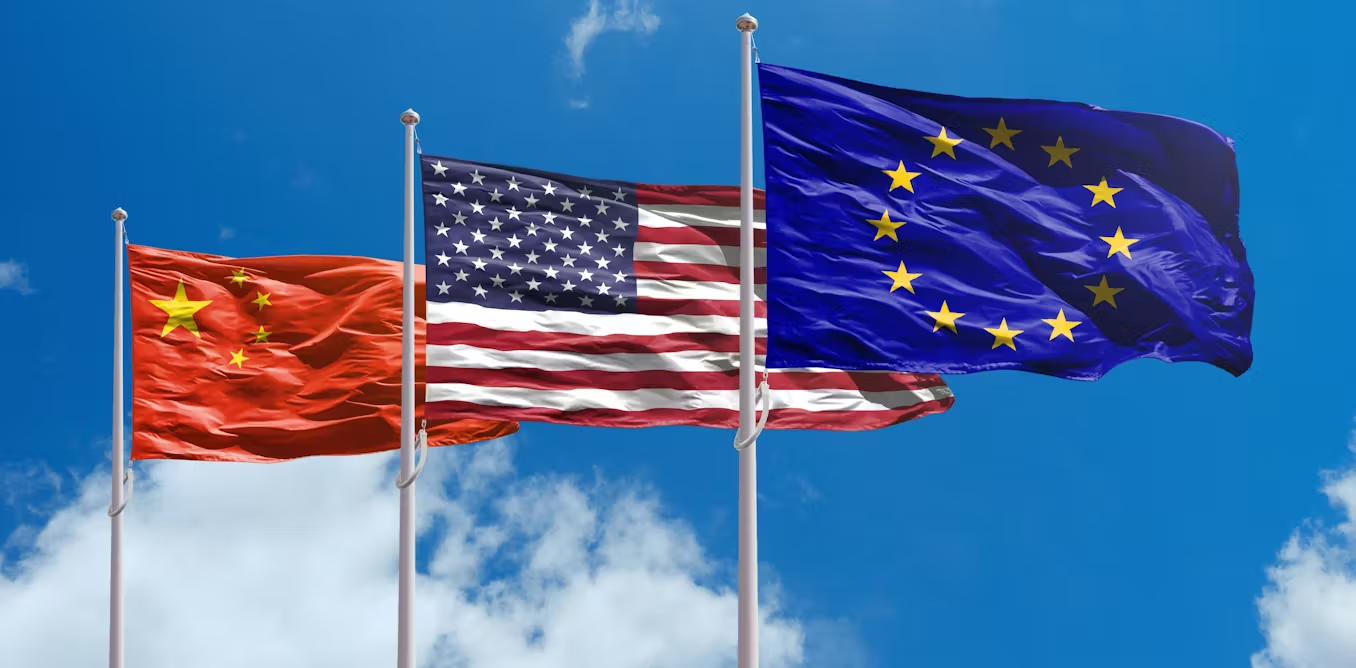
WASHINGTON / BRUSSELS The United States and the European Union on Thursday announced a synchronized wave of tariffs targeting Chinese electric vehicles, advanced semiconductors, and low-carbon industrial materials, escalating economic tensions with Beijing and rattling global financial markets.
The coordinated action framed by Western officials as a defensive response to state-subsidized overcapacity erased an estimated $1.2 trillion in global equity value in early trading and marked a decisive shift toward a unified trans-Atlantic trade posture against China.
The measures, set to take effect on July 1, signal a departure from the fragmented trade disputes of the past decade and raise the risk of renewed global trade fragmentation at a time when policymakers had been counting on a fragile economic recovery in the second half of 2026.
What Happened
In near-simultaneous announcements in Washington and Brussels, officials outlined a new Harmonized Fair Trade Framework, aligning tariff regimes across the two largest Western economic blocs.
The Measures
Under the plan, the United States will raise tariffs on Chinese electric vehicles and battery components to 45%, while the European Union will impose a new Carbon-Tech Adjustment Duty ranging from 20% to 35%. The EU’s measures will also extend to industrial inputs such as low-carbon steel and aluminum.
The Rationale
Joint statements from US and EU officials cited evidence of non-market overproduction and state subsidies that they say distort global prices and undermine domestic manufacturing.
“We are not closing our doors to trade,” a senior US administration official said. “We are closing loopholes that allow subsidized predatory pricing to erode our industrial base.”
The Timing
The announcement follows months of closed-door negotiations under the Trade and Technology Council framework and comes just ahead of the scheduled mid-2026 review of the United States-Mexico-Canada Agreement. Importers have a narrow five-month window to adjust supply chains before the tariffs take effect.
Why It Matters
A Structural Shift in Global Trade
Unlike earlier disputes, the move represents a coordinated strategy rather than unilateral action. By aligning tariff regimes, Washington and Brussels effectively force third-party manufacturing hubs including Mexico, Vietnam, and India to reassess their exposure to Chinese supply chains if they want continued access to Western markets.
Analysts say the policy creates the foundations of a de facto Western trade bloc centered on industrial security rather than cost efficiency.
Market Reaction
Financial markets responded sharply.
- The S&P 500 fell 2.4% at the open, led by losses in consumer discretionary and technology shares.
- Germany’s DAX dropped 2.1%, reflecting concerns over retaliation against Europe’s export-heavy auto sector.
- In Asia, Hong Kong’s Hang Seng Index slid 3.8%, while the yuan weakened past 7.35 per dollar.
Inflation Versus Growth
Economists warn the tariffs risk injecting new inflationary pressure into the global economy.
The International Monetary Fund recently projected global growth of 3.3% in 2026, driven in part by AI-related productivity gains. However, higher input costs for clean-energy technologies could slow investment and complicate efforts by central banks to bring inflation closer to target levels in both the United States and the euro area.
Supply Chains Under Pressure
The policy explicitly targets transshipment the practice of routing Chinese goods through third countries to avoid tariffs placing new scrutiny on North American and Southeast Asian manufacturing corridors.
US officials indicated that continued preferential access under USMCA may depend on whether Mexico and Canada adopt comparable external tariff measures, a signal that the agreement’s upcoming review could become a leverage point in broader trade negotiations.
Some analysts described the emerging framework as a “North Atlantic trade perimeter,” effectively prioritizing geopolitical alignment over cost efficiency.
Expert and Institutional Reaction
Reactions across economic and diplomatic circles were sharply divided.
“This is the geopolitical equivalent of crossing the Rubicon,” said Dr. Elena Rossi, chief global economist at the Peterson Institute for International Economics. “By acting in concert, the US and EU have turned partial decoupling into a structural reality. The efficiency losses will show up in measurable GDP drag.”
In Beijing, officials reacted forcefully. China’s Ministry of Commerce warned that the measures amounted to protectionism and violated World Trade Organization principles, signaling that retaliatory steps were under consideration. The Ministry of Commerce of China said it would take “resolute and proportional countermeasures” to protect Chinese interests.
Central bank watchers also expressed concern. A strategist at BlackRock noted that the added trade friction could complicate rate-cut plans at the Federal Reserve and the European Central Bank, potentially extending a higher-for-longer interest-rate environment into 2027.
What Happens Next
Retaliation Risk
Markets are now focused on Beijing’s response, expected in the coming days. Analysts see European luxury goods, US agricultural exports, and critical minerals as likely pressure points.
Corporate Adjustment
Multinational firms with exposure to China-linked supply chains including automakers and consumer-electronics manufacturers are expected to intensify lobbying efforts in Washington and Brussels, seeking carve-outs for components with limited alternative sourcing.
The USMCA Factor
Attention is also turning to Mexico. With the trade pact’s review approaching, Mexico City may face pressure to align its tariff policies with the US-EU framework or risk diminished access to North American supply chains.
Historical Context
While trade tensions between China and the West are not new, the level of coordination sets this episode apart. During the 2018–2019 trade disputes, Washington frequently acted alone, even targeting allies with steel and aluminum tariffs.
The current alignment recalls Cold War-era export-control regimes such as Coordinating Committee for Multilateral Export Controls, though analysts note a key difference: China today is deeply embedded in global production networks, increasing the risk of widespread economic spillovers.
Outlook
Thursday’s announcement marks a turning point in global trade policy. By prioritizing industrial security and supply-chain resilience, the United States and the European Union have signaled a willingness to accept higher costs and slower growth in exchange for strategic control.
As markets absorb the shock, the next phase will depend on Beijing’s response and on whether the world’s largest economies move toward negotiation or slide further into a prolonged trade confrontation.
Sources
- White House statements and briefings
- European Commission press releases
- International Monetary Fund economic outlook
- Market data from major global exchanges
- Commentary from Peterson Institute for International Economics
- Central bank communications from the Federal Reserve and European Central Bank
Financial Disclaimer
This article is provided for informational and journalistic purposes only. It does not constitute financial, investment, tax, or legal advice, nor should it be relied upon as a basis for making financial decisions. The views and analysis presented are based on publicly available information at the time of publication and are subject to change without notice.
Readers should conduct their own research or consult with a licensed financial advisor, tax professional, or legal expert before making investment or policy-related decisions. Neither the author nor the publisher assumes any liability for actions taken based on the information contained in this article.