By Staff Financial Correspondent | March 13, 2026
The Triple Pressure Facing the U.S. Economy
Over the past week, several major economic developments have converged to create a challenging moment for the U.S. economy. New government data shows economic growth slowed more than previously believed. At the same time, escalating conflict in the Middle East has pushed oil prices sharply higher, and the latest inflation report confirms that price pressures remain stubbornly persistent.
Individually, each of these developments would draw significant attention from economists and policymakers. Together, they present a complex environment where slowing growth, rising energy costs, and ongoing inflation are intersecting at once.
For American households, the consequences could appear quickly through higher gasoline prices, potential shifts in interest rate policy, and increased volatility in financial markets.
Understanding what is happening and what it could mean in the months ahead requires looking closely at the key forces shaping the economy right now.
GDP Growth Revised Sharply Lower
One of the most significant updates came from the U.S. Bureau of Economic Analysis, which released its second estimate for fourth-quarter economic growth on March 12.
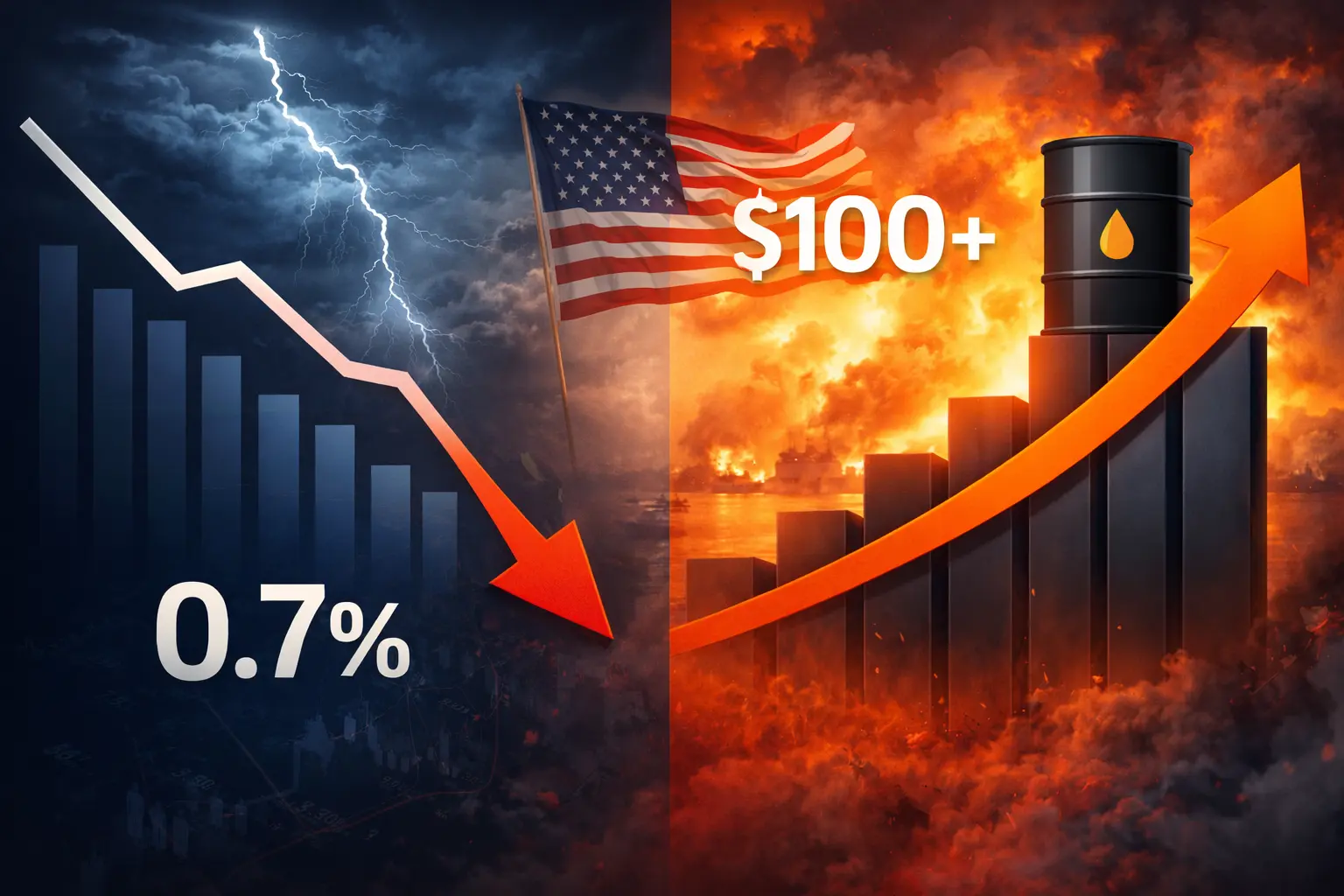
The revised data showed that U.S. GDP grew at an annualized rate of just 0.7% in the fourth quarter of 2025, sharply lower than the initial estimate of 1.4%.
The revisions affected several major components of the economy:
- Consumer spending was lower than initially reported
- Exports declined more sharply than earlier estimates suggested
- Government spending was revised downward
- Business investment slowed more than first measured
At the same time, imports fell less than expected, which also reduced the final growth figure.
As a result, total U.S. economic growth for 2025 now stands at 2.1%, slightly below the earlier estimate of 2.2% and noticeably slower than the 2.8% growth recorded in 2024.
The revised numbers also highlight how quickly momentum weakened toward the end of last year. Just one quarter earlier, the U.S. economy had expanded at a robust 4.4% pace in Q3 2025. The sharp slowdown into the final quarter suggests that growth lost strength more rapidly than initially believed.
Some economists have also pointed to the impact of a temporary government shutdown during the period, which reduced federal spending and contributed to the softer growth figures.
Middle East Conflict Sends Oil Prices Higher
At the same time economic growth data was being revised downward, global energy markets were reacting to a sharp escalation of tensions in the Middle East.
Military strikes involving Israel and Iran intensified an already unstable regional situation, sending shockwaves through oil markets.
During the week:
- Brent crude oil briefly moved above $100 per barrel
- West Texas Intermediate (WTI) approached $119 per barrel at its peak
- Oil prices surged more than 10% in a single day on March 12
Supply concerns grew as several regional developments raised fears of disruption to global energy shipments. Iraq and Kuwait announced production reductions, while Qatar temporarily halted shipments of liquefied natural gas amid security threats.
Markets have been particularly focused on the Strait of Hormuz, a narrow shipping passage through which roughly one-fifth of the world’s oil supply passes. Any disruption to traffic through the strait could significantly affect global energy supplies.
Oil markets remain volatile. By March 13, WTI crude had retreated to about $93.44 per barrel, though prices remain roughly 39% higher for the year and more than 50% higher over the past month.
Even with the pullback, the rapid increase in oil prices is likely to filter through to consumers in the form of higher gasoline prices and rising transportation costs.
Inflation Remains Persistent
Another important update came from the Bureau of Labor Statistics, which released the February Consumer Price Index (CPI) report on March 11.
The report showed that consumer prices rose 0.3% in February, bringing the annual inflation rate to 2.4%.
Core inflation which excludes volatile food and energy categories was 2.5% year over year.
Several key categories continue to put pressure on household budgets:
- Food prices increased 0.4% during the month
- Energy prices rose 0.6%
- Shelter costs climbed 0.2%
While the overall inflation numbers were broadly in line with economists’ expectations, the underlying details suggest that inflation has not fully returned to the Federal Reserve’s long-term target of around 2%.
The recent spike in oil prices also raises the possibility that future inflation readings could move higher again if energy costs continue rising.
What This Means for American Households
The combination of slower growth, higher energy costs, and persistent inflation creates a difficult environment for both policymakers and consumers.
Higher Energy Costs
When oil prices rise quickly, gasoline prices typically follow within days or weeks. That means households may soon see higher costs at the pump.
Energy costs also ripple throughout the broader economy. Transportation, manufacturing, agriculture, and airline travel all rely heavily on fuel, meaning rising oil prices can gradually push up prices across many goods and services.
For families already managing higher living costs, even modest increases in fuel prices can significantly affect monthly budgets.
A Difficult Decision for the Federal Reserve
The Federal Reserve now faces a complicated balancing act.
If economic growth continues to weaken, policymakers may want to lower interest rates to support economic activity. But if inflation remains elevated especially because of rising energy prices cutting rates too quickly could reignite price pressures.
This tension between slowing growth and persistent inflation is one reason some economists have begun cautiously discussing the possibility of stagflation, a situation where economic growth slows while inflation remains elevated.
Rising Borrowing Costs
Financial markets also reacted to the week’s developments. Major stock indexes moved lower as investors reassessed the economic outlook.
During the week:
- The S&P 500 declined by more than 130 points
- The Nasdaq dropped roughly 280 points
- The Dow Jones Industrial Average remains modestly negative for the year
At the same time, U.S. Treasury yields rose as investors priced in the risk of higher inflation driven by energy costs.
Higher Treasury yields often translate into higher borrowing costs across the economy, including mortgage rates, credit cards, and business loans.
Banking Policy Changes Could Support Lending
One development that could partially offset some economic pressure came from the Federal Reserve’s regulatory side.
Fed Vice Chair Michelle Bowman outlined proposed updates to the Basel III bank capital framework, which governs how much capital banks must hold against potential losses.
The proposed changes aim to better align capital requirements with the actual risk of bank assets while simplifying certain rules for smaller institutions.
For large banks, the reforms may modestly reduce capital requirements in some areas, while smaller community banks could benefit from simplified regulatory calculations designed to support traditional lending.
If implemented, the changes could help encourage continued lending to households and businesses during a period of economic uncertainty.
What Americans Should Watch Next
Several upcoming developments will likely determine whether the current economic turbulence proves temporary or evolves into a more serious slowdown.
Oil prices remain the most immediate risk. If geopolitical tensions ease and energy markets stabilize, inflation pressures could also moderate. However, further disruption in the Middle East could push energy prices even higher.
Upcoming inflation data will be critical. The next CPI report, expected in April, will show whether rising energy prices are beginning to influence broader consumer prices.
Economic growth data will also be closely monitored. First-quarter GDP figures later this spring will provide the first clear look at whether the slowdown observed in late 2025 continued into 2026.
Finally, Federal Reserve guidance will remain one of the most important signals for financial markets, as policymakers attempt to navigate the competing pressures of inflation and economic growth.
Conclusion
The U.S. economy enters the second quarter of 2026 facing a complicated set of challenges. Slowing growth reduces the economy’s cushion against external shocks, while rising energy prices risk adding new inflationary pressure.
At the same time, financial markets are reacting to heightened uncertainty about the path ahead for interest rates and global stability.
None of these developments guarantee a recession. The labor market remains relatively resilient, and consumer spending continues to support much of the economy.
However, the margin for error has narrowed. The coming months particularly developments in energy markets, inflation data, and Federal Reserve policy will likely determine whether the current pressures ease or intensify.
For now, both policymakers and households are watching the same indicators closely, looking for signs of whether the U.S. economy can maintain its footing in an increasingly uncertain global environment.
Financial News Disclaimer
Disclaimer:
This article is for informational and educational purposes only and should not be considered financial, investment, or legal advice. Financial markets and economic conditions can change rapidly. Readers should conduct their own research or consult a qualified financial professional before making investment or financial decisions. DollarDailyNews.com and its authors are not responsible for any financial actions taken based on this content.