
By Sahil Mehta
Senior Financial Analyst, DollarDailyNews.com
Friday, February 13, 2026
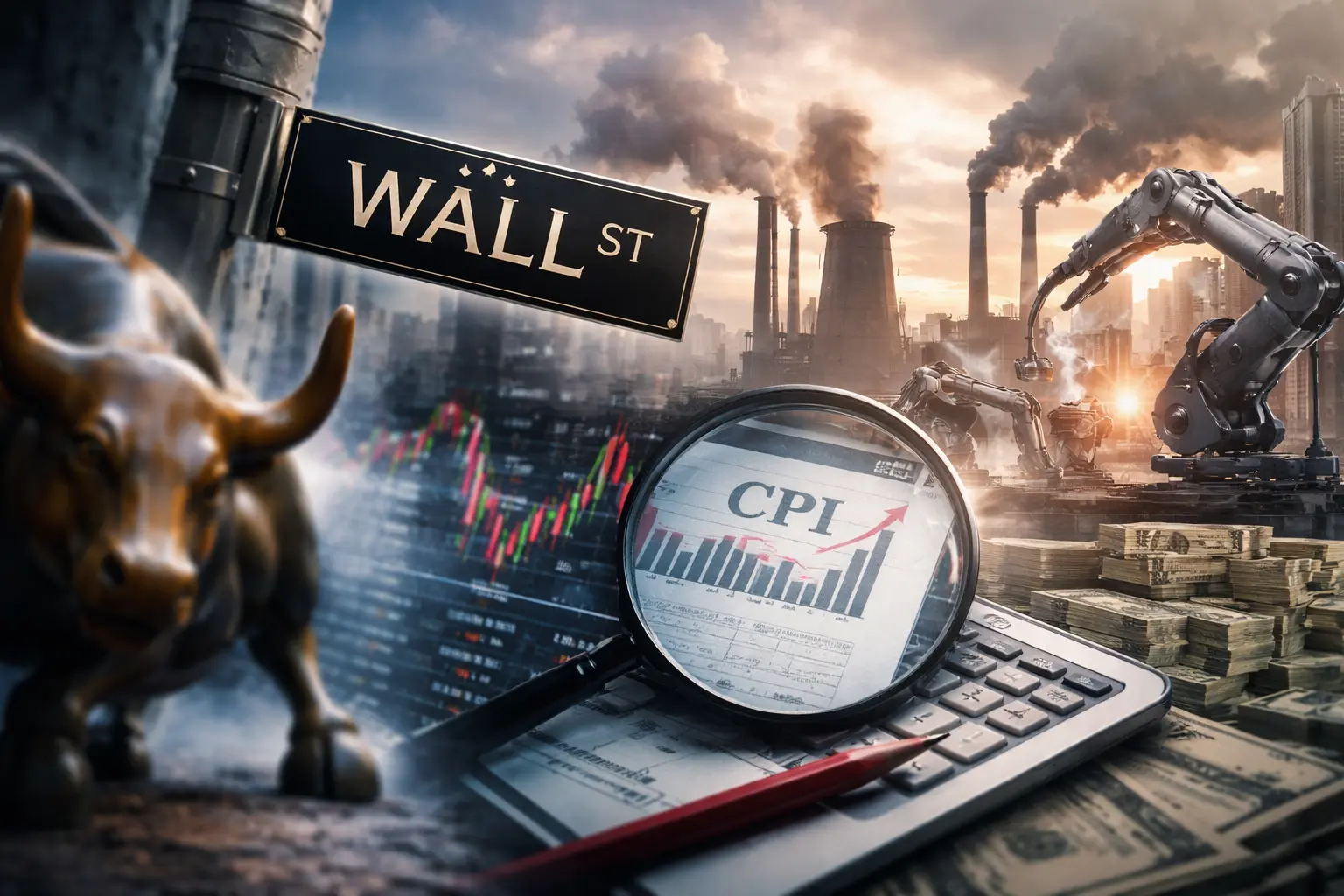
WALL STREET :- It feels strangely appropriate that today falls on Friday the 13th.
As trading began this morning, the U.S. economy found itself facing a rare and uncomfortable convergence of risks. Not one major data point. Not two. But three powerful forces colliding at once: a pivotal inflation report, growing unease over Big Tech’s massive AI spending, and a labor market that looks far less solid than the headlines suggest.
In more than a decade of closely tracking financial cycles, I’ve learned that markets become most vulnerable not during obvious crises but during periods of confusion. Today is one of those moments.
For American households, investors, and retirees, the stakes could hardly be higher. This is no longer about whether growth is slowing. It is about whether financial markets have been pricing in an economic reality that may not fully exist.
1. The CPI Verdict: The Last Stand for Rate Cuts
All eyes are on the Bureau of Labor Statistics this morning as it releases the January 2026 Consumer Price Index (CPI). Economists expect annual inflation to cool to 2.5%, down from 2.7% in December.
On paper, that may sound like progress. In practice, it is everything.
A difference of just two-tenths of a percent may determine the Federal Reserve’s next move for months.
At present, the Fed remains effectively frozen. After holding benchmark rates in the 3.75%–4.00% range, policymakers are reluctant to cut too early and risk reigniting inflation.
If today’s CPI comes in above 2.6%, hopes for meaningful rate cuts in mid-2026 may evaporate.
That would have immediate consequences:
- Mortgage Rates: Already near 6.8%, a hotter reading could push rates back above 7%.
- Auto Loans: With delinquencies climbing, higher rates will further suppress demand.
- Household Budgets: Elevated borrowing costs continue to squeeze middle-income families.
The “Hidden” Inflation Problem
While headline inflation has moderated, core services remain stubbornly high. Insurance premiums, shelter costs, healthcare, and utilities continue rising faster than wages.
For many households, this “hidden inflation” matters more than any government statistic. It is quietly eroding purchasing power month after month.
2. The $200 Billion Gamble: Is the AI Bubble Leaking?
While policymakers focus on inflation, equity markets are wrestling with a different shock.
This week, Amazon sent ripples through Wall Street by announcing plans to spend $200 billion on AI and robotics in 2026 a nearly 60% increase year over year. Alphabet has projected roughly $180 billion in similar investments.
Together, these numbers have triggered what many traders are now calling a “Capex Panic.”
For two years, investors rewarded nearly any company that mentioned artificial intelligence. Profitability took a back seat. Growth stories ruled.
Now, the mood has shifted.
The Core Fear
Markets are beginning to question whether AI spending is outpacing realistic revenue growth. Data centers, advanced chips, and infrastructure require enormous capital, and returns may take years to materialize.
In plain terms: Big Tech is burning cash faster than it is generating profits.
Market Fallout
- Amazon shares dropped roughly 9% after the announcement.
- Investors are now watching Nvidia and Microsoft closely for signs of slowing demand.
- Any weakness in guidance could spark a broader tech sell-off.
Why Your Retirement Is Exposed
Because major indexes are heavily weighted toward technology, AI-driven volatility is not confined to Silicon Valley. It flows directly into retirement portfolios.
Most Americans with 401(k)s are far more exposed to tech risk than they realize. If AI valuations compress, the entire market feels the impact.
3. The “Phantom” Labor Market
Perhaps the most troubling signal comes from employment data.
At first glance, January’s jobs report appeared healthy: 130,000 jobs added and unemployment falling to 4.3%.
But beneath the surface, the picture is far less reassuring.
The Bureau of Labor Statistics recently released substantial downward revisions to 2025 employment figures. In effect, much of last year’s reported job growth has been erased.
Revised data now suggests that 2025 was the weakest year for job creation since the pandemic.
A Dangerous Contradiction
We now have solid-looking January numbers resting on a weakened foundation.
Growth appears increasingly narrow:
- Healthcare and government hiring account for most gains.
- Manufacturing, retail, and technology remain stagnant.
- Private-sector momentum is fading.
Wage Pressures
With labor demand softer than headline numbers imply, negotiating power is shifting back to employers. Meaningful wage growth is becoming harder to secure.
For consumers already dealing with high prices, this is an uncomfortable reality.
The Collision Course: What This Means for Americans
Taken together, sticky inflation, unstable tech valuations, and fragile job growth create a challenging environment.
None of these forces alone would be alarming. Combined, they form a systemic risk.
The “Fed Trap” Scenario
One of the greatest dangers now is a policy mistake.
If policymakers focus too heavily on January’s job gains and ignore last year’s revisions, they may conclude that the economy remains overheated.
Rates could stay elevated longer than necessary based on incomplete data while underlying growth weakens.
History shows that such miscalculations often precede recessions.
Strategic Analysis and Practical Takeaways
From my perspective, the era of effortless market gains is behind us. 2026 is shaping up to be a year that rewards discipline, diversification, and patience.
Here are the steps I believe deserve serious consideration:
1. Review Your Tech Exposure
Many portfolios are unintentionally concentrated in large-cap technology through index funds.
That is not inherently wrong—but it is a risk.
Consider whether your current allocation reflects your true risk tolerance. Defensive sectors such as healthcare, utilities, and infrastructure may offer greater stability in volatile periods.
2. Prioritize Fixed-Rate Security
If you carry variable-rate debt, reducing it should be a priority.
With inflation likely to remain in the 2.5%–3.0% range, meaningful rate cuts may continue to be delayed. Planning for “higher for longer” is the prudent approach.
3. Strengthen Your Cash Buffer
Revised labor data is a reminder that job security can deteriorate quietly.
Maintaining an emergency fund covering six months of expenses earning competitive yields remains one of the most underrated financial strategies.
4. Track Your Personal Inflation
Government averages rarely reflect individual experience.
Monitor your own major expenses: insurance, housing, taxes, healthcare, and services. These costs are unlikely to fall meaningfully in the near term. Budget accordingly.
The Bottom Line
Today’s CPI report will set the short-term tone for markets. But the deeper story lies in shifting AI economics and quietly weakening labor foundations.
Inflation sets the temperature. Structural change defines the climate.
In 2026, caution is not pessimism it is preparation.
About the Author
Sahil Mehta is a Senior Financial Analyst and UX Strategist. He writes about market psychology, economic cycles, and personal finance at DollarDailyNews.com.
⚠️ Financial Disclaimer
The information provided in this article is for educational and informational purposes only and does not constitute financial, investment, tax, or legal advice. All opinions expressed are those of the author and are based on publicly available data and personal analysis at the time of writing. Readers should consult with a licensed financial advisor or qualified professional before making any investment or financial decisions. Past performance is not indicative of future results.