
By Sahil Mehta, Global Markets Correspondent
New York January 31, 2026
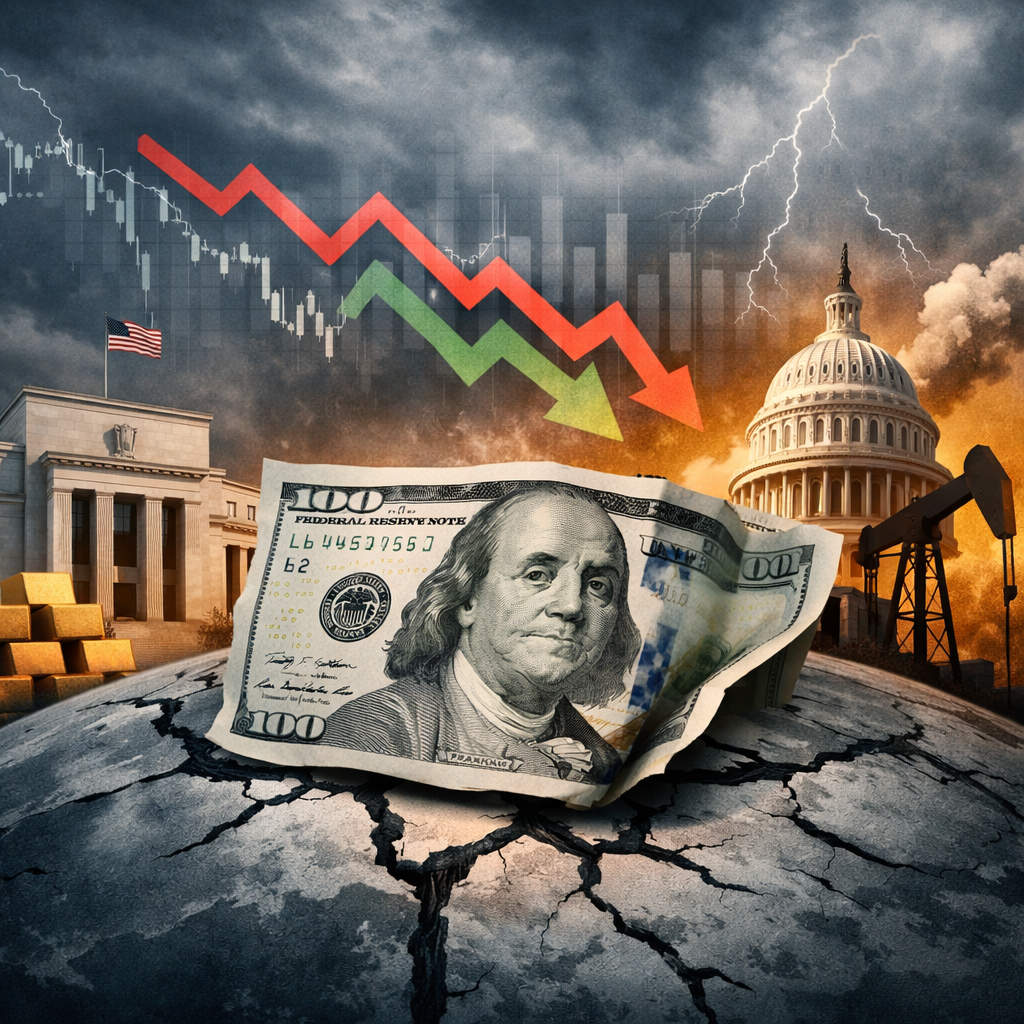
The U.S. dollar is ending January 2026 not as a safe harbor, but as the eye of a financial storm.
For decades, the greenback followed a simple rule: when the world felt uncertain, investors rushed into dollars. Wars, recessions, pandemics capital always flowed back to the United States.
That rule no longer holds.
In the opening weeks of 2026, the dollar has been caught between a central bank fighting to preserve its independence, a White House openly pushing for devaluation, and a global commodities market quietly reducing its reliance on U.S. currency. The world’s reserve currency is no longer just moving with markets. It is being pulled apart by politics.
As trading desks close a chaotic January, investors are facing a rare divergence: the dollar is weakening sharply against Europe while battering emerging markets at the same time that gold flirts with historic highs near $5,000 an ounce.
It is a picture of a currency searching for its identity.
The Fed Holds the Line. For Now
This week, the Federal Reserve voted to keep its benchmark interest rate in the 3.50%–3.75% range.
The decision itself was expected. The vote behind it was not.
The split 10 in favor, 2 against revealed growing internal tension. Governors Christopher Waller and Stephen Miran dissented, arguing for an immediate rate cut. Their opposition highlights how narrow the Fed’s path has become.
Two forces are now colliding:
Inflation Pressure
Core inflation remains stubbornly close to 3%, driven in part by tariffs introduced last year.
Economic Cooling
Job growth is slowing. Hiring is steady, but momentum is fading.
At his press conference, Chair Jerome Powell emphasized data over politics, insisting that policy decisions would remain evidence-based. But markets are already looking past him.
With Powell’s term ending in May, attention has shifted to his potential successor. On Friday, Donald Trump nominated Kevin Warsh as the next Fed Chair a move that immediately rattled bond markets and sent volatility higher.
“The market is pricing in a regime change,” says Elena Rodriguez, Senior FX Strategist at Pantheon Macroeconomics. “Powell represents institutional independence. Warsh signals political alignment. That changes everything.”
A Tale of Two Dollars
Normally, the dollar moves in one direction against the rest of the world.
Right now, it is moving in two.
Weak Against Europe
Against the euro and British pound, the dollar has slid to multi-month lows.
The euro is trading above $1.18, supported by the European Central Bank’s decision to pause rate cuts. Investors, once obsessed with U.S. assets, are now favoring Europe’s relative political stability.
It is a reversal of the post-pandemic era, when American markets were seen as the world’s safest bet.
Strong Against Asia and Emerging Markets
In Asia, the story is very different.
Japan
The yen continues to slide despite warnings from the Bank of Japan. Down nearly 13% year over year, it remains trapped by the carry trade, as U.S. yields stay far above Japanese rates.
India
The rupee hit a record low near 92 per dollar this week, pressured by foreign capital outflows.
China
Trade tensions and tariffs continue to weaken the yuan, keeping the dollar artificially strong against Chinese currency.
In practical terms, this means Asian and emerging economies are absorbing most of the pain from dollar strength.
The “Anti-Dollar” Trade: Gold at $5,000
If currencies reflect confidence, gold reflects fear.
This month, gold briefly breached $5,000 per ounce before pulling back on profit-taking. The move was not driven by inflation alone.
It was driven by trust.
“Central banks are voting with their balance sheets,” says Dr. Aris Thorne of Zurich Capital. “They’re buying gold and reducing exposure to U.S. debt. That’s not about short-term cycles. That’s about long-term credibility.”
When gold reaches record highs while interest rates remain elevated, markets are signaling concern about sovereign debt and fiscal discipline—not just economic slowdown.
Oil tells a different story.
WTI crude remains stuck near $59 per barrel, weighed down by non-OPEC supply. For many emerging exporters, this is a nightmare scenario: their debts are denominated in expensive dollars, while their primary export earns less.
Emerging Markets: Under Maximum Pressure
The combination of political uncertainty and high U.S. rates is squeezing developing economies.
Although the dollar index sits below its 2024 peak, the impact is uneven. Some countries are facing severe stress.
The Debt Wall
Dollar-denominated loans remain costly to refinance. For countries in Africa and South America, servicing debt is becoming increasingly difficult.
Capital Flight
Uncertainty around Fed leadership is pushing money back into U.S. technology stocks and Treasuries, draining liquidity from riskier markets.
Still, not everyone is pessimistic.
“If rate cuts arrive in mid-2026, we could see a major rebound,” says Sarah Liu, emerging markets economist at BNP Paribas. “A weaker dollar would unleash significant capital inflows.”
Outlook: All Eyes on May
As February begins, markets are focused on one date: the Fed leadership transition in May.
For now, volatility is the base case.
Futures markets are pricing in roughly a 60% chance of a rate cut in March. That probability changes almost daily, depending on headlines from Washington.
Key Risks for the Next Quarter
The Warsh Premium
Will investors demand higher bond yields if they believe inflation discipline is weakening?
Geopolitics
Rising tensions in the Middle East could trigger an oil shock that upends current assumptions.
Liquidity Stress
The recent collapse in silver and late-month gold selling suggests thin market depth.
Taken together, these risks point to continued instability.
For now, the dollar remains the “cleanest dirty shirt” in global finance. But the stains are growing more visible—and alternatives are slowly emerging.
Quick Explainer: Why a Strong Dollar Hurts Other Countries
When the dollar rises, global trade becomes more expensive.
Most commodities oil, food, metals are priced in dollars. A stronger dollar means foreign buyers must spend more of their local currency.
Debt becomes harder too.
Example:
If India owes $1 million and the rupee weakens from 83 to 92 per dollar, that debt effectively becomes about 10% more expensive overnight even if interest rates stay the same.
Nothing changed.
A Personal Note from the Author
After covering currency markets for years, one thing is clear: this is not a normal cycle.
In past downturns, investors disagreed about timing. They didn’t disagree about trust. The U.S. dollar was still viewed as the ultimate fallback.
That assumption is now being questioned in ways I have never seen before.
When central banks quietly move into gold, when allies diversify reserves, and when politics openly pressures monetary policy, something deeper is happening. It signals unease not panic, but discomfort.
For everyday people, this matters more than most headlines suggest. A volatile dollar shows up in your life as higher insurance premiums, unpredictable travel costs, more expensive imported goods, and shrinking purchasing power.
In my own budgeting, I’ve noticed it too. Subscriptions creep higher. Flights cost more. Long-term planning feels harder. These are small signals, but together they form a pattern.
The dollar is not collapsing. But it is no longer unquestioned. And once trust starts to erode, rebuilding it takes years not months.
Financial Disclaimer
This article is provided for informational and educational purposes only and does not constitute financial, investment, tax, or legal advice.
The views expressed are based on publicly available data, professional analysis, and personal observations at the time of writing. Financial conditions, markets, and regulations may change without notice.
Readers should not rely solely on this information when making financial decisions. Before investing, trading, or making significant financial choices, consult with a qualified financial advisor, tax professional, or legal expert who understands your individual situation.
DailyDollarNews.com and its contributors are not responsible for any losses, damages, or consequences resulting from the use of information published on this website.
By using this content, you acknowledge that you are solely responsible for your financial decisions.
Except the currency.