

Even with incomes above $80K, many Americans feel broke. Discover the real reasons rising costs, debt traps, and hidden financial pressures in 2026.
Last Updated: April 2026
Data Sources: U.S. Census Bureau, Federal Reserve, BEA, BLS, CMS
Executive Summary
In 2026, the financial reality for many Americans is increasingly paradoxical:
- Median household income exceeds $83,000
- Yet a majority still feel financially constrained
This is the “wealth illusion”, where income appears strong, but rising costs, debt, and systemic pressures erode real financial stability. (The Complete Guide to Personal Finance in the United States (2026 Edition)
Key Financial Indicators (2024–2026)
| Metric | 2024 | 2026 | Trend |
|---|---|---|---|
| Median Household Income | $83,730 | $83,730 | ⚠️ Flat |
| Personal Savings Rate | 5.2% | 4.5% | 🚨 Declining |
| Total Household Debt | $17.5T | $18.8T | 📈 Rising |
| Avg. Monthly Housing Cost | $1,650 | $1,784 | 📈 Rising |
The Illusion of “High Income”
A salary of $80K–$100K was once seen as financial security. Today, it often isn’t.
You might reach that milestone and expect relief only to find yourself still checking your account before everyday purchases.
This isn’t an individual failure. It’s structural.
- Roughly 57% of Americans live pay cheque to pay cheque.
- Real purchasing power has remained largely flat since 2023
Income has increased nominally, but costs have risen faster where it matters most. (Why Most Budgets Fall Apart After 90 Days)
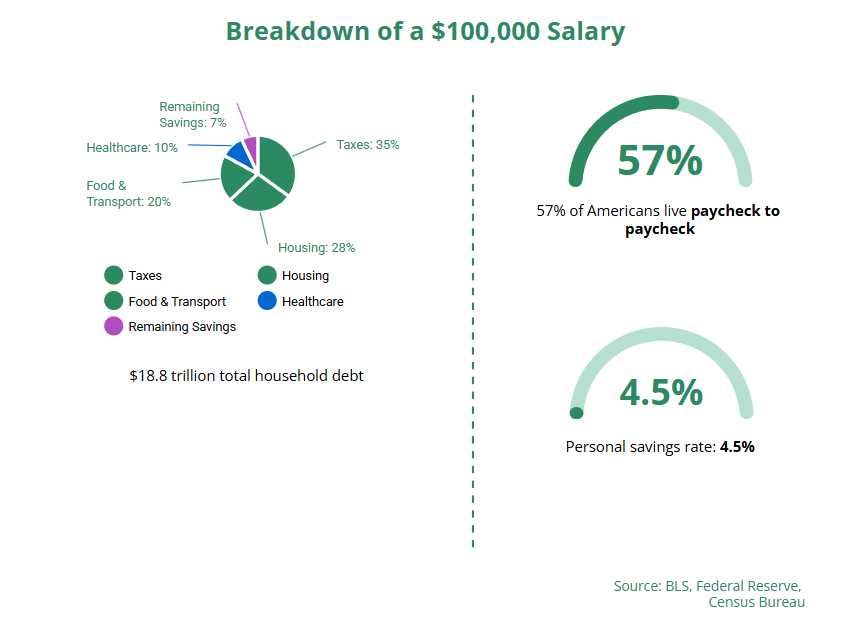
The Math Problem: Where the Money Actually Goes
On paper:
- Average household expenses: ~$61,334/year
- Median income: ~$83,730/year
It looks manageable.
But in reality:
- Taxes significantly reduce take-home pay
- Housing consumes ~35% of expenses
- Essentials dominate spending
What remains is often minimal.
Savings tell the real story:
- Late 2025: 3.6% savings rate
- Early 2026: ~4.5%
Economists consider 5–7% the minimum safe range, meaning many households are operating below stability.
Lifestyle Inflation: The Raise That Disappears
When income rises, spending often follows.
This is known as hedonic adaptation; your “new normal” becomes more expensive.
Case Study: The $20K Raise Trap
- Income: $58K → $78K
- New expenses:
- Rent upgrade → +$4,800/year
- Car loan → +$5,760/year
- Dining, subscriptions → +$7,500/year
Result: Little to no real financial progress.
Higher income doesn’t automatically build wealth; it often funds a higher-cost lifestyle.
The Debt Machine: $18.8 Trillion and Growing
Debt is one of the biggest reasons high earners remain financially stuck.
- Total US household debt: $18.8 trillion
- Credit card debt: $1.28 trillion
Why It’s Dangerous
Credit cards now carry the following:
- 21–24% average interest rates
At these levels:
- Minimum payments barely reduce the principal.
- Debt can persist for years
Buy Now, Pay Later (BNPL) has made this worse by separating spending from immediate consequences.
The Hidden Costs Most People Ignore
Even careful budgets often miss key expenses.
Housing (Beyond Rent)
- Maintenance
- Insurance
- Property taxes
These costs are rising faster than inflation. (The Six-Figure Debt Trap: Why High-Income Americans Still Carry Credit Card Debt)
Healthcare
- National health spending continues to grow ~4–5% annually
- Premium increases quietly erode income gains
Childcare
- Average infant care: ~$13,935/year
For many families, childcare can exceed rent or mortgage payments.
The COLA Gap
- Social Security adjustment (2026): 2.8%
- Inflation: ~3%+
Even small gaps like this compound over time, reducing real income.
The Psychological Trap: Spending to Keep Up
Money struggles aren’t just financial; they’re behavioural.
Modern spending is heavily influenced by:
- Social media comparison
- Lifestyle expectations
- Perceived “normal” living standards
When everyone appears to be living better, spending increases just to keep pace.
This creates a cycle where:
Spending is driven more by perception than necessity.
Action Plan: Breaking the Cycle
Improving financial stability requires intentional systems, not just higher income.
1. The “Ghost Raise” Strategy
Automatically save or invest any salary increase.
If you never see it, you won’t spend it.
2. Eliminate Invisible Spending
Audit your last 60–90 days:
- Subscriptions
- Convenience spending
- Hidden fees
Most households recover $200–$500/month this way.
3. Attack High-Interest Debt First
Prioritise debt above 7% interest.
At current rates, credit card debt is one of the fastest ways to lose financial control.
4. Focus on Net Worth (Not Income)
Income looks impressive.
Net worth builds freedom.
Net Worth = Assets – Liabilities
Final Takeaway
The financial reality in 2026 is clear:
- High income alone is no longer enough
- Rising costs and systemic pressures reshape financial stability
The real shift is this:
Income determines lifestyle.
Financial discipline determines freedom.
Understanding this difference is what separates those who feel stuck from those who build lasting security.
Sources & References
- U.S. Census Bureau — Income Reports
- Bureau of Economic Analysis (BEA) — Savings Data
- Federal Reserve — Household Debt Reports
- Bureau of Labor Statistics (BLS) — CPI Data
- CMS — Healthcare Spending Reports
Disclaimer
This content is for informational purposes only and does not constitute financial advice. Readers should consult a qualified financial professional before making financial decisions.