
Key Takeaways
- Simple investing: Index funds let you own hundreds of companies with a single investment.
- Low costs: Most index funds charge dramatically lower fees than actively managed funds.
- Strong long-term results: Over long periods, most professional fund managers fail to beat broad market indexes.
- Accessible: Many brokerages allow investors to start with very small amounts of money.
Introduction
If you have ever considered investing but felt overwhelmed by the idea of choosing individual stocks, you are not alone. For many beginners, the stock market can feel complicated and intimidating.
Fortunately, there is a simpler and widely recommended approach: index fund investing.
Index funds allow you to invest in hundreds of companies at once through a single fund. You do not need to analyze individual stocks or constantly monitor the market. Instead, you own a small portion of an entire market index and allow it to grow over time.
This strategy is widely recommended by financial experts, including Warren Buffett, because it combines diversification, low costs, and long-term growth potential.
In this guide, we will explain what index funds are, how they work, and how beginners can start investing in them. (The Complete Guide to Personal Finance in the United States (2026 Edition)
What Is an Index Fund?
An index fund is an investment fund designed to track the performance of a specific market index.
A market index is simply a collection of stocks or bonds used to measure how a segment of the market performs.
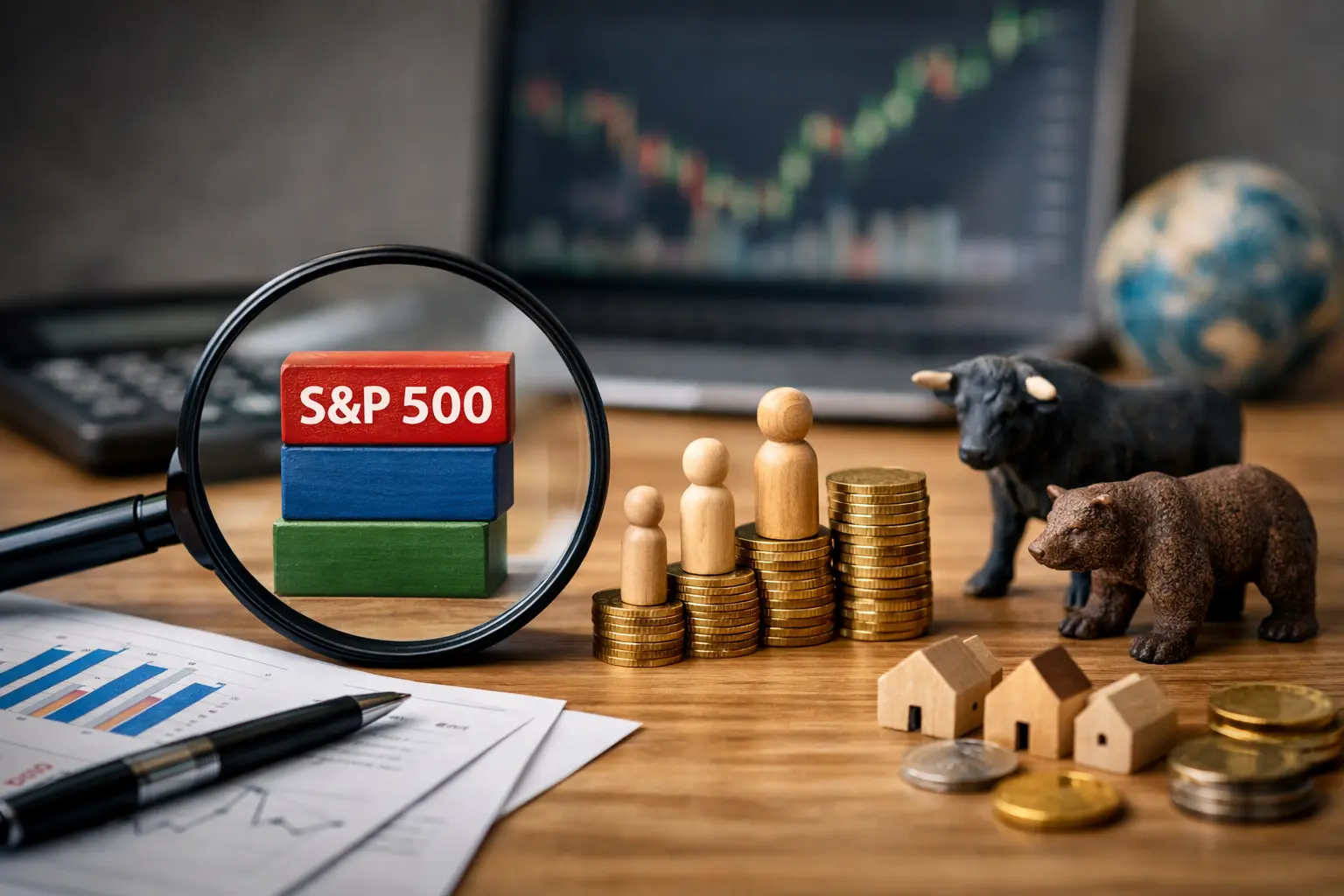
One of the most well-known examples is the S&P 500, which tracks roughly 500 of the largest publicly traded companies in the United States, including companies such as Apple, Microsoft, Amazon, and Johnson & Johnson.
When you invest in an S&P 500 index fund, you are effectively buying a small share of each company in that index.
Index funds are typically structured in two ways:
Mutual Funds
Purchased directly from the fund provider and priced once per day.
Exchange-Traded Funds (ETFs)
Trade on stock exchanges throughout the day like individual stocks.
The defining characteristic of index funds is passive management. Instead of trying to beat the market by picking individual stocks, the fund simply aims to match the performance of the index it tracks.
How Index Funds Work
Index funds follow a straightforward process.
A fund manager selects a market index to track and builds a portfolio that mirrors that index as closely as possible.
For example, if a company represents 7% of the S&P 500, the index fund will allocate roughly 7% of its assets to that stock.
When the index changes, the fund adjusts its holdings accordingly.
Because this strategy requires very little active trading or research, index funds offer several advantages.
Lower fees
Passive management requires fewer analysts and less trading activity, which keeps costs low.
Transparency
Investors can easily see what companies the fund owns because it mirrors a public index.
Tax efficiency
Less trading generally means fewer taxable capital gains distributions compared with actively managed funds. (Investing Basics for Americans: A Beginner’s Guide to Building Wealth)
Why Index Funds Are So Popular
Index funds have grown dramatically in popularity over the past two decades. Today, passive funds account for a large and growing share of investment assets in the United States.
Several factors explain this shift.
Simplicity
Investors do not need to analyze financial statements or predict which stocks will outperform. A single fund can provide exposure to an entire market.
Low Costs
Fees have a significant long-term impact on investment returns. Even a 1% difference in annual fees can reduce a portfolio by tens of thousands of dollars over several decades.
Competitive Performance
Long-term studies from S&P Dow Jones Indices show that the majority of actively managed funds fail to outperform their benchmark indexes over extended periods.
Advantages of Index Funds
Instant Diversification
A single index fund can provide exposure to hundreds or even thousands of companies across multiple industries.
This diversification reduces the risk that a single company’s decline will severely damage your portfolio.
Extremely Low Fees
Many index funds charge annual expense ratios between 0.03% and 0.10%, far below the typical 0.50% to 1.50% charged by actively managed funds.
Tax Efficiency
Because index funds trade less frequently, they tend to generate fewer taxable capital gains distributions.
Easy to Start
Many brokerages allow investors to purchase fractional shares or begin investing with very small amounts of money.
Risks and Limitations
Although index funds are widely considered one of the best tools for long-term investors, they are not risk-free.
Market risk
If the overall market declines, index funds will decline with it.
No outperformance
An index fund is designed to match the market, not beat it.
Limited customization
Because the fund tracks an index, investors cannot easily exclude individual companies.
Index Funds vs. Actively Managed Funds
Actively managed funds attempt to outperform the market by selecting individual stocks and adjusting the portfolio based on market conditions.
However, long-term data suggests that consistently beating the market is extremely difficult.
According to the SPIVA (S&P Indices Versus Active) scorecard, the majority of actively managed U.S. equity funds underperform their benchmark indexes over 10- to 15-year periods.
| Feature | Index Funds | Actively Managed Funds |
|---|---|---|
| Average Expense Ratio | 0.03% – 0.10% | 0.50% – 1.50% |
| Strategy | Passive (tracks index) | Active stock selection |
| Long-term results | Matches market returns | Most fail to outperform |
| Tax efficiency | Higher | Lower |
One famous example illustrates this difference. Warren Buffett once made a $1 million wager that a simple S&P 500 index fund would outperform a group of hedge funds over a decade. The index fund won comfortably.
Historical Market Returns
While past performance does not guarantee future results, historical data provides a useful benchmark.
Since its inception in 1957, the S&P 500 has delivered an average annual return of roughly 10% before inflation.
Examples of major index funds include:
| Index or Fund Type | Approximate Historical Return | Description |
|---|---|---|
| S&P 500 (VOO / SPY) | ~10% long-term | Tracks large U.S. companies |
| Total Stock Market (VTI) | ~12–14% over some recent 10-year periods | Includes large, mid, and small-cap companies |
| Nasdaq-100 (QQQ) | ~20% during the past decade | Technology-heavy and more volatile |
Returns vary significantly depending on the time period and market conditions.
How Beginners Can Start Investing in Index Funds
Getting started with index funds is surprisingly simple.
1. Open a brokerage account
Major brokerages such as Vanguard, Fidelity, and Charles Schwab offer low-cost investment accounts.
2. Use tax-advantaged accounts when possible
Retirement accounts such as a 401(k), Roth IRA, or Traditional IRA can offer significant tax benefits.
3. Choose a broad index fund
Many investors begin with a Total Stock Market fund or an S&P 500 index fund as a core investment.
4. Invest regularly
Setting up automatic monthly contributions helps build wealth through dollar-cost averaging.
5. Keep fees low
Look for funds with expense ratios below 0.10%.
6. Stay invested for the long term
Markets fluctuate in the short term, but long-term investing allows compounding to work in your favor.
Popular Index Funds for Beginners
Some of the most widely used low-cost index funds include:
Vanguard S&P 500 ETF (VOO)
Expense ratio around 0.03%.
Vanguard Total Stock Market ETF (VTI)
Provides exposure to nearly the entire U.S. stock market.
Fidelity 500 Index Fund (FXAIX)
Known for one of the lowest expense ratios among S&P 500 funds.
Each of these funds provides broad diversification and low costs, making them popular choices for long-term investors.
Final Thoughts
Index funds are not flashy, but they are one of the most reliable ways for everyday investors to participate in long-term market growth.
By combining broad diversification, low costs, and a simple strategy, they provide a practical path for building wealth over time.
For beginners, the most important steps are straightforward: choose a broad index fund, invest regularly, and stay invested for the long term.
Disclaimer:
This article is for educational purposes only and does not constitute financial advice. Investors should consider their financial situation and consult a qualified financial professional before making investment decisions.